Slide title
Write your caption here
Button
Slide title
Write your caption here
Button
Slide title
Write your caption here
Button-
Slide title
Write your caption here
Button
Slide title
Write your caption here
Button
Slide title
Write your caption here
Button
Slide title
Write your caption here
Button-
Slide title
Write your caption here
Button
ABOUT

PARTIZAN. PATIENT ENGAGEMENT SPECIALISTS.
A lot of people talk about health outcomes.
A lot of companies think they understand patients.
But in today’s world, what does it really mean to get the patients from where they are to where they want to be?
At Partizan, for the last 15 years we’ve been getting unprecedented results by looking at health outcomes a little differently.
Of course everyone says that.
But we have the results and traction to prove it.
Let;s take a step back so you can see how we got to where we are today.
PATIENTS ARE A VERY SPECIFIC AUDIENCE.
Are they go on very specific journeys.
You need to understand every touch point.
Every interaction.
And not just understand, but know what each interaction and issue actually means to people.
You also need a central repository that is constantly storing and analysing patient data and feedback so that you can adjust and solve issues in real time.
You need highly trained support staff with intimate knowledge of treatment protocols.
And you need a real patient community that regularly gives feedback and insights across a broad spectrum of disease states.
You also need to be able to measure results and have a process that allows companies to make better decisions about their treatment and support protocols.
This is a world that changes by the day. So you need something that can adapt quickly and efficiently. And you need a system that can pull all of this together.
THAT’S WHY WE BUILD GUARDIAN
our proprietary cloud based patient management platform that powers our programs.
It’s a patient ecosystem and it sits under everything we do
It can tell us what to do and when who to speak to and how
What’s working and what’s not and where we can help patients the most
It helps us get patients closer to where they want to be…
A health coach
An empowerment tool
An overall better patient experience.
Take a different look at patient health outcomes.
PARTIZAN. BETTER HEALTH OUTCOMES. MORE ENGAGING PATIENT EXPERIENCES.



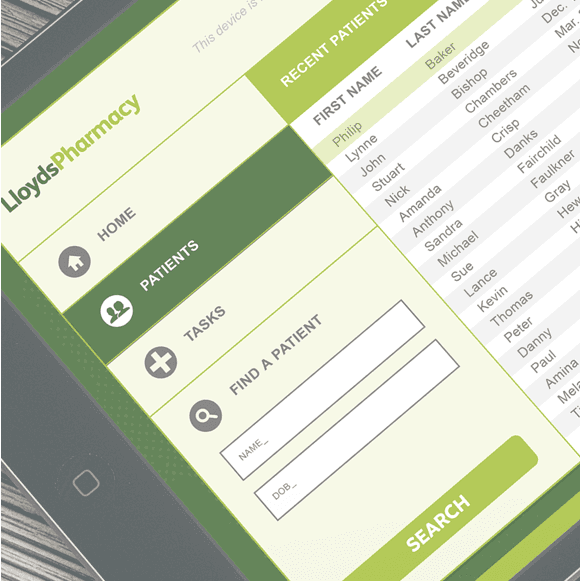


GUARDIAN PATIENT MANAGEMENT PLATFORM
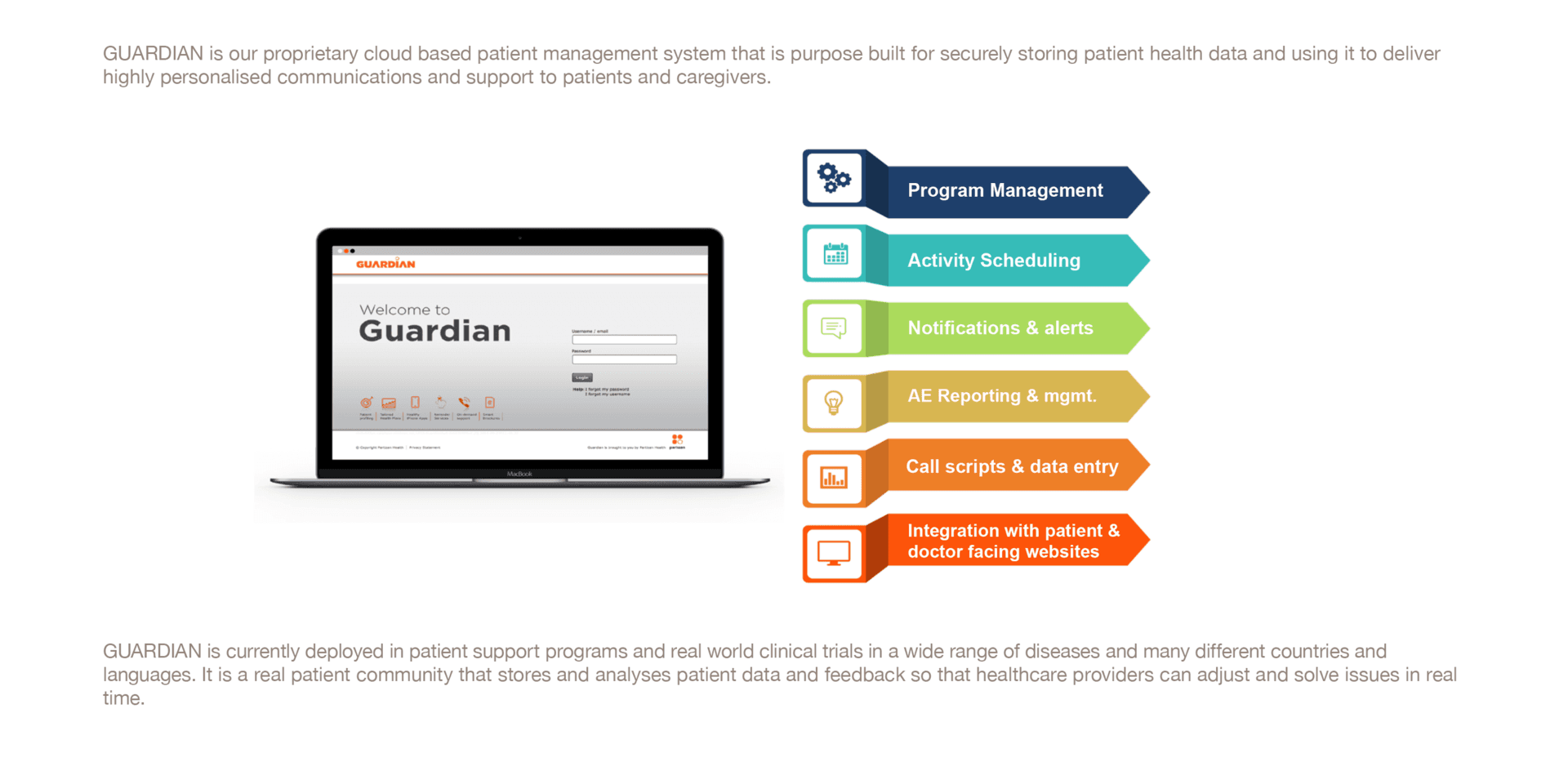
GUARDIAN PATIENT MANAGEMENT PLATFORM
GUARDIAN is our proprietary cloud based patient management system that is purpose built for securely storing patient health data and using it to deliver highly personalised communications and support to patients and caregivers.
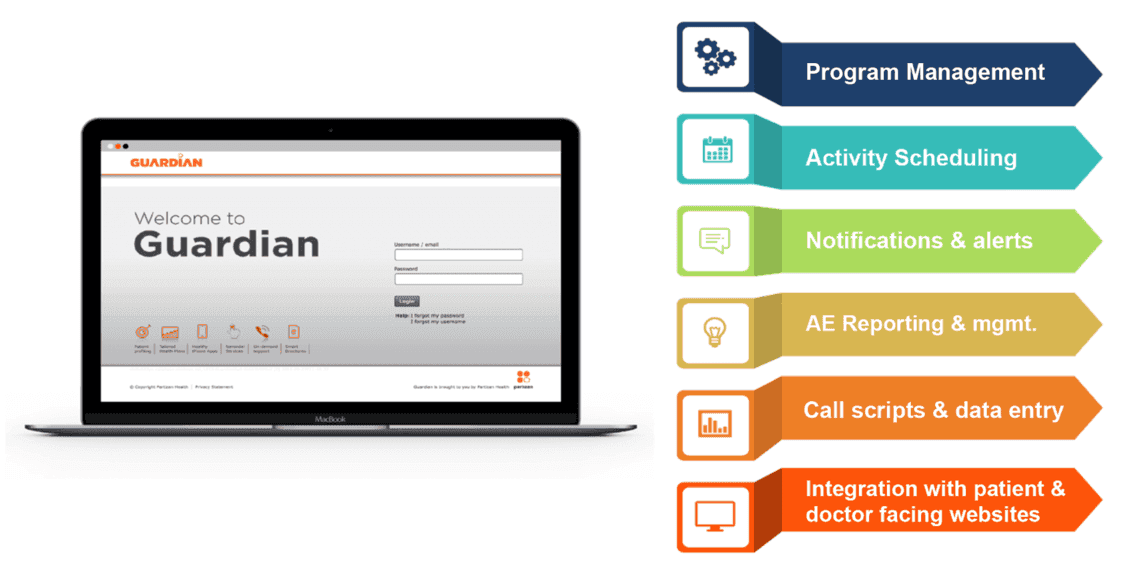
GUARDIAN is currently deployed in patient support programs and real world clinical trials in a wide range of diseases and many different countries and languages. It is a real patient community that stores and analyses patient data and feedback so that healthcare providers can adjust and solve issues in real time.
BEYOND HEALTHCARE
WHILST IT IS HARD TO PREDICT THE FUTURE, THERE ARE CHANGING LANDSCAPES IN HEALTHCARE THAT ARE JUST TOO HARD TO IGNORE.
THE SANDS ARE SHIFTING AT GREAT SPEED AND IN ORDER TO BE THERE WHEN THEY SETTLE WE’VE INNOVATED OUT AND ADAPTED OUR BUSINESS MODEL AND FOCUS.
TECHNOLOGY & HEALTHCARE ARE COLLIDING!
Despite significant advances in drug development and diagnostics, there has been little disruption in healthcare delivery and the patient experiences. We see huge opportunity for technology to bring pharma into the relevancy of this century and make health delivery and consumption feel more like the interactions we have everyday with Uber, Airbnb, Amazon and Expedia.
PATIENT CENTRED CONTROL IS INEVITABLE.
The fast growing tide of ‘social group help treatment’ and the democratization of knowledge and expertise means there will be a tipping point and shift in the way that people treat themselves. We see doctors becoming more like freelancers in the future and communities of pseudo experts will pop up around demand. Testing will increasingly be delivered to the home or office and micro communities of likeminded health advocates will rise.
THE CONCEPT OF INFORMED PATIENT CHOICE IS NEW AND POWERFUL!
Patients telling us how they want their care delivered is relevant to the changing dynamic of the patient-doctor relationship and how they want to live their lives. Partizan has been working with our manufacturer clients and homecare partners globally to pioneer new community care models that give patients back control of where and how they receive their infusions, injections or other care, so as little of their life changes as possible.
CONSUMERISM & PATIENT EMPOWERMENT IS DRIVING CHANGE IN PATIENT SUPPORT.
Most notably a shift away from traditional education & adherence to holistic disease management programs with the goal of enhancing patient engagement, retaining brand loyalty, and preventing switch to biosimilars or competitor brands.
MARKERS AND PREVENTION.
While preventative medicine has been a buzz word for the last 20 years has failed to deliver any real quantifiable results. However, the advancement of new markers that tell us before a disease flips over threshold and taking preventative measures in relation to those is where governments should be heading. Genetics and gene analysis has proven disappointing and not as useful as first thought. So new tools will take its place in terms of prediction of medical event threshold markers.
BIG DATA, ML AND AI.
These will also be used to tailor make protocols and programmes for the patient. Individual medicine will become the norm, standard generic treatments will be adapted. ML and AI will also lead to innovation pipeline and more direct marketing funnels to the patient. Data in healthcare is still notoriously unreliable and sporadic. Better, quicker and more accessible ways to accessing information and building pictures will be critical.
THE RISE OF CHRONIC AND RARE DISEASES.
These will only escalate against a backdrop of limited resource and help. Governments and healthcare systems will be unable to cope with the frequency of these diseases using their current structures. Other modes of intervention will be needed that don’t rely on old models of health and wait times.
REAL WORLD PATIENT DATA IS BECOMING A VALUABLE COMMODITY.
In this compelling future of fast tracked approvals for expensive targeted therapies and personalised medicines, we see real world patient data becoming a valuable commodity for speciality medicines that need to continually justify their values. Patizan’s highly configurable iPad platforms for collecting PROM / PREM data is currently deployed in PSP’s, clinical trials and registries in over 400 clinics around the world.
WHAT THIS MEANS FOR PARTIZAN IS TIGHTER AND MORE DEVELOPED RELATIONSHIPS WITH UNIVERSITIES, LABS AND PATIENT GROUPS.
IT MEANS CREATING PATIENT CENTERED TOOLS AND UTILITIES THAT CAN ADAPT WITH THIS CHANGING LANDSCAPE.
AND IT MEANS INVESTING IN A NOW, NEXT
AND NEW
MODEL.
TAKE A DIFFERENT LOOK AT PATIENT HEALTH OUTCOMES.
CONTACT US
Josh Taylor
Managing Director+44 (0)207 636 6662+44 (0) 779 567 5271josh.taylor@partizanhealth.co.uk
James TaylorStrategic Director+44 (0) 207 636 6662+44 (0) 7595 514325james.taylor@partizanhealth.co.uk
Stephanie KennedyGeneral Manager+44 (0) 207 636 6662+44 (0) 7473130128skennedy@partizanhealth.co.uk
Designed by Altitude